Fire Engine for Amsterdam-Amstelland
Year 1 Project Assignment
In emergency situations, every second counts, but Amsterdam’s historic city centre poses a major obstacle for traditional fire engines. For this project, I developed the ‘F.I.R.E.’: a compact, zero-emission vehicle that, thanks to active four-wheel steering, can manoeuvre even through the narrowest alleys of the Jordaan district. By building a physical mock-up, I not only validated the packaging and electronics, but also demonstrated its manoeuvrability in practice.
Project F.I.R.E - redefining Urban Firefighting
Concept development of a zero-emission and ultra-manoeuvrable fire engine for Amsterdam city centre.
Anyone who has ever been to the Jordaan or Amsterdam’s canal district knows how beautiful but also how cramped it is there. For the fire service, these narrow streets pose a huge risk. Current standard fire engines (tankers) are simply too big. They get stuck behind illegally parked cars or cannot negotiate the bends on the historic bridges.
In emergency situations, every second counts. When a fire engine has to take a detour or gets stuck, precious ‘golden minutes’ are lost. Commissioned by Kenbri Fire Fighting, my team and I developed the F.I.R.E. (Frontline Incident Rescue Engineer): a vehicle that can get anywhere, yet still possesses all the power of a large fire engine.
problem statement
Due to the increase in population and tourism (source: Amsterdam City Council), the fire engine is not manoeuvrable enough for the narrow, obstructed streets of Amsterdam’s city centre. As a result, it takes the fire service longer than necessary to reach the scene of an emergency. This poses a risk to human lives and increases the potential for damage.
Main question
The main question is: What alternative vehicles or equipment could be used instead of the fire engine to reduce the fire service’s response time in the city centre of the Amsterdam–Amstelland region?
Scenario Analysis
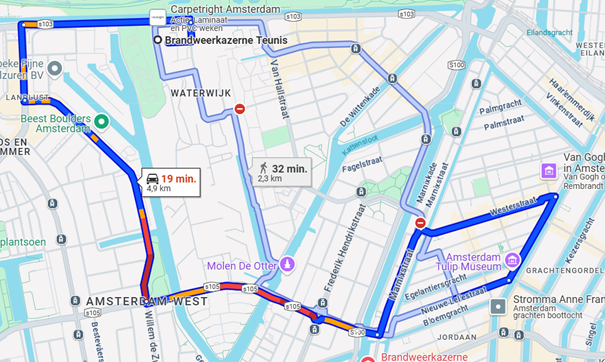
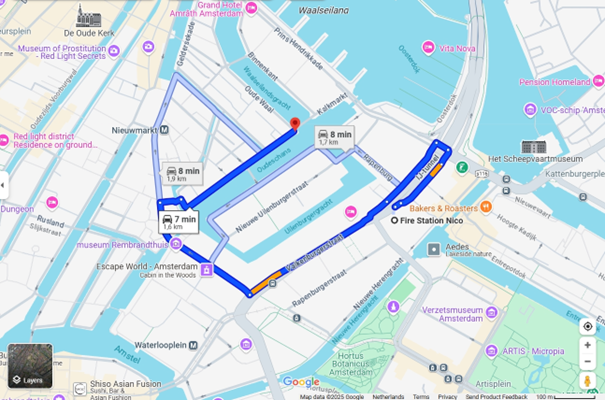
We didn’t start drawing straight away, but began by analysing the situation first. We used data from the Nico and Teunis fire stations in Amsterdam to create the two most common scenarios: a house fire in the city centre and a vehicle fire involving multiple vehicles. These situations mean that the fire brigade’s response time is increased by the narrow streets and cars parked partially on the road, which forces the fire engine to take a detour.
Packaging
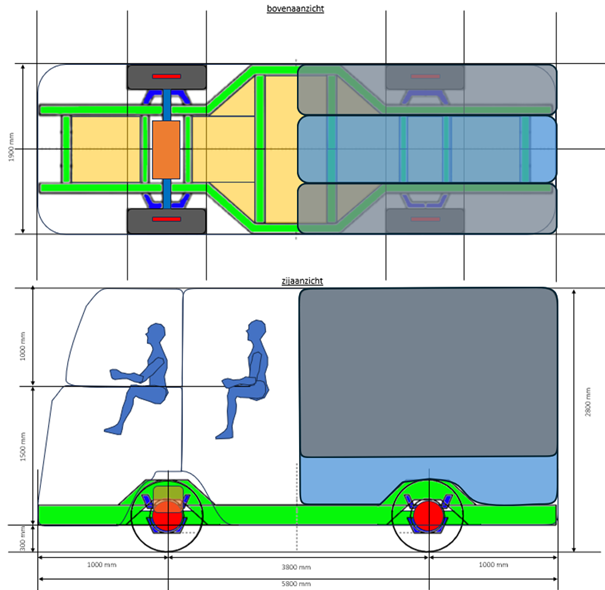
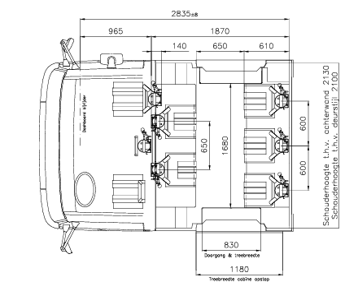
This was the biggest challenge: how do you fit the equipment of a massive lorry into a vehicle that is barely wider than a luxury saloon car? We call this process ‘packaging’.
- The main requirement: There had to be space for 1,500 litres of water and a full crew of five firefighters.
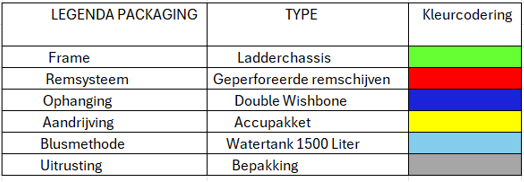
- Smart layout: By positioning the water tank centrally and low in the middle, we created stability and a low centre of gravity. The crew are grouped around it, so that upon arrival they can immediately retrieve their breathing apparatus and tools and get to work.
- Skateboard frame: We have used this method to integrate a skateboard frame with a ladder-type chassis. This means that the vehicle’s battery pack is incorporated into the chassis. This ensures better vehicle stability thanks to an even distribution of weight.
- 100% Electric: No more roaring diesel engine. Partly to meet Amsterdam’s environmental standards, the F.I.R.E. is powered by a powerful 200 kW electric motor and a 300 kWh lithium-ion battery pack. This is not only good for the environment, but also ensures that the car accelerates at lightning speed (instant torque), which is essential after every bend.
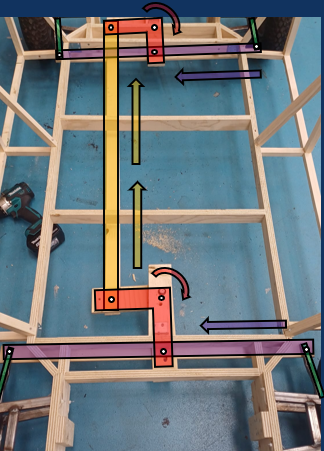
- Four-Wheel steering(4WS): This is the vehicle’s ‘secret sauce’. Not only the front wheels, but also the rear wheels steer. This allows the vehicle to turn almost ‘on its own axis’, enabling it to manoeuvre through narrow streets where a standard van would struggle. This reduces the turning circle by approximately 30%. We have also managed to incorporate this four-wheel steering system into the wooden mock-up.
From computer to reality (The Mock-up)
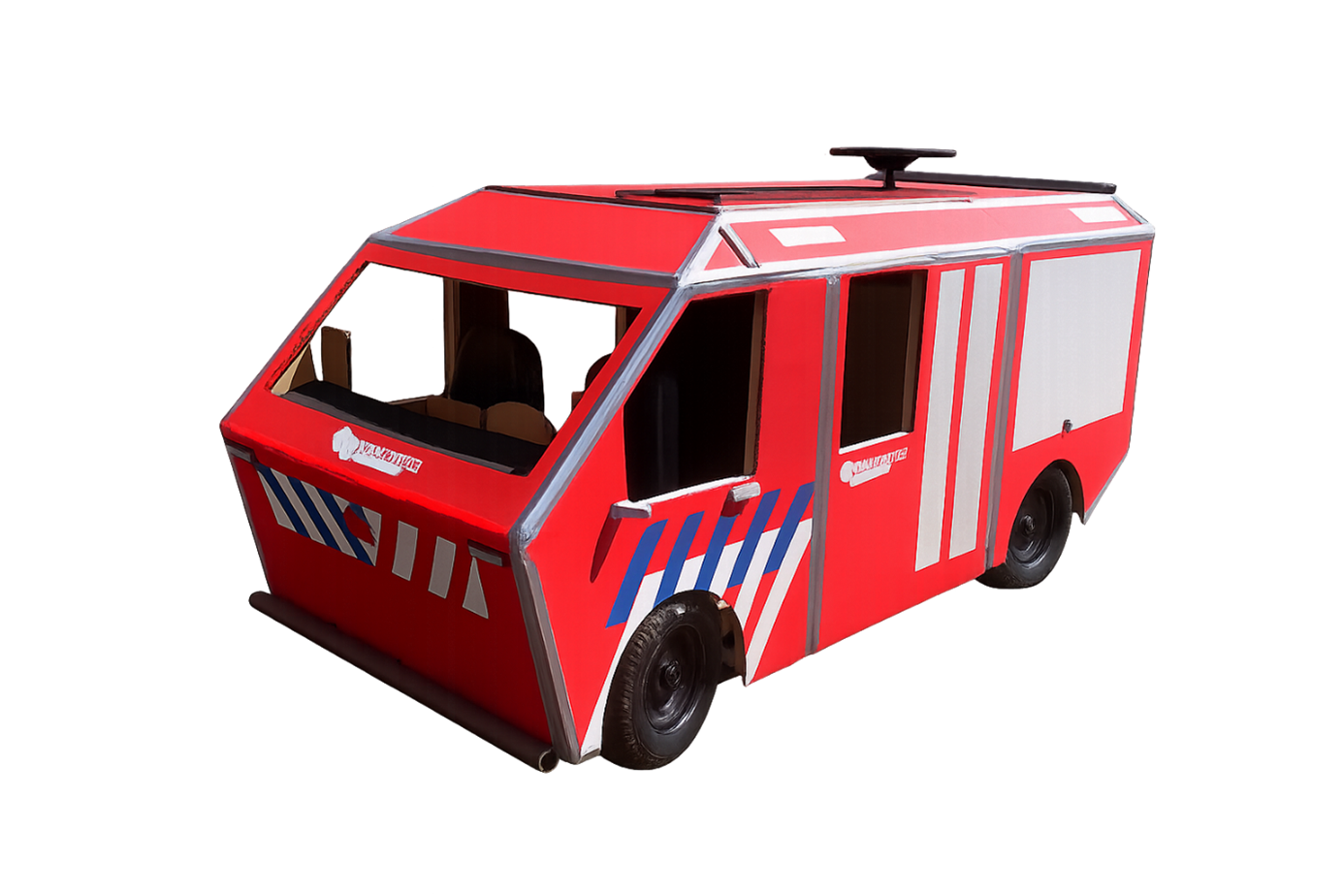
To bring the design to life, we eventually built a 1:10 scale model. We constructed this from wood and cardboard. The scale model features four-wheel steering, implemented using a wooden mechanism that ensures the front wheels turn in unison with the rear wheels.
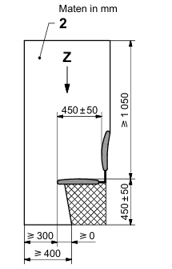
During this project, we based our design on compliance with NEN-EN 1846. This is the regulatory documentation setting out the legal requirements that a fire engine must meet, including the dimensions for crew seating, for example. Using this documentation, we were able to validate our design and produce a design that was as realistic as possible. We received a great deal of praise for this from our course, as we were the only project team to have implemented the legal requirements in the project.
Here is the full documentation of this Project(in Dutch).
NEN-EN 1846: 313f205c-9836-43f2-8414-d2caee8cd035
Document: 0602f5e4-2328-4e86-93ff-b6ada23f717a
Grade: 7
visualisations
Below are the analyses and the corresponding inventor drawings.