Bracket optimalisation Mini Cooper R53 S
Year 2 Assignment Efficient Vehicle
During this project, I investigated how to optimise the intercooler mounting brackets on a 2004 Mini Cooper R53 S. The intercooler is currently mounted on top of the engine, which results in a loss of power due to heat soaking. Fitting a heavier Airtec intercooler results in increased power and greater forces on the mounting brackets.
Using various simulation programmes, I have optimised these mounting brackets to meet the specified requirements.
Intercooler Bracket Optimalisation Mini Cooper R53 S
integrated system simulation & structural optimisation
During this project, I optimised the intake system of a modified Mini Cooper R53. By combining a larger Airtec intercooler with an innovative simulation chain (Simulink → MSC Adams → Abaqus), I lowered the intake temperature and reduced the weight of the mounting points by 88%, whilst ensuring structural safety under extreme dynamic loads.
Problem statement
The Mini R53 often suffers from heat soak due to the position of the supercharger. Following engine tuning (17% pulley, Catcams 469), the intake temperature rose to critical levels (52 degrees). The solution was to fit a larger Airtec intercooler. However, this presented a new challenge: a heavier component (4.8 kg) mounted on top of a vibrating engine. My aim was to design new mounting points that are lighter than the original steel, yet strong enough to withstand the 240 hp engine roll.
Flowchart
To achieve the best possible design, I have integrated three specialist software packages: MATLAB/Simulink, MSC Adams and Abaqus:
MATLAB/simulink
To determine the boundary conditions, I have developed a longitudinal vehicle model. This model acts as a ‘Virtual Dyno’ and comprises the following elements:
- Adiabatic Compression: Modelling the heat output of the Eaton M45 based on SC speed and efficiency maps.
- Thermal Feedback Loop: Implementation of a variable intercooler efficiency (ηη) as a function of vehicle speed and airflow.
- ECU Emulation: A 2D lookup table that adjusts engine torque based on the Intake Air Temperature (IAT) and engine speed, taking into account the improved compression ratio of the Catcams 469.
- Results: A reduction in peak IAT from 50°C to 36°C, which enabled a power increase of approximately 30 hp (to a total of 240 hp).
MSC Adams
The figures from Simulink do not directly translate into component failure; movement is required for that. I exported the torque curve from Simulink as a spline function to MSC Adams. This resulted in the following simulation and insights:
- Engine Roll simulation: The engine block has been modelled using flexible bushings with specific stiffness (KK) and damping (CC) values to simulate the engine’s tilt during acceleration and gear changes.
- Transient Force Extraction: Mounting the 4.8 kg intercooler on the engine created a leverage effect. During the ‘launch’ and gear changes, the solver calculated a peak horizontal force of 450 Newtons at the mounting points.
- Insight: The dynamic load was found to be more than 18 times higher than the static weight of the intercooler, which demonstrated the need for a thorough FEA analysis
Abaqus
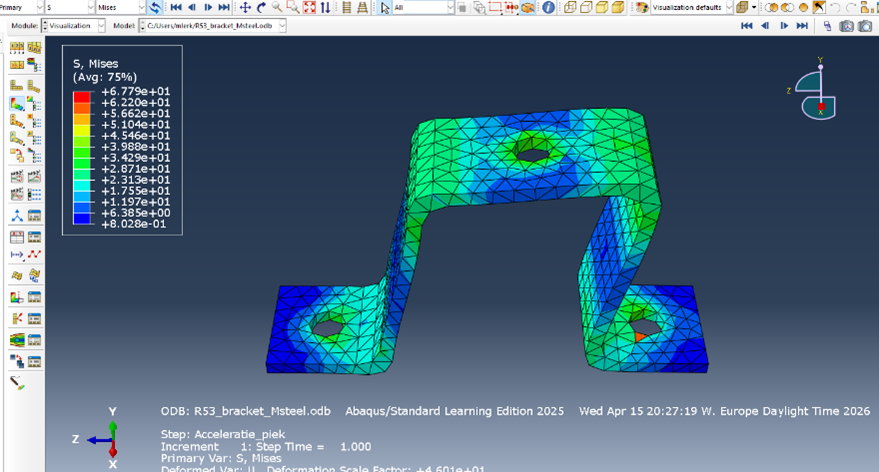
In Abaqus, FEA analyses were used to test the bracket against the 450 N impact load from Adams and thermal expansion. First, the current steel bracket was tested. This simulation gave us a maximum von Mises stress of 68 MPa. The yield strength of the metal is 235 MPa, which means that the current bracket has a safety margin of 3.45. The desired safety factor lies between 1.2 and 1.5.
Material Substitution
Firstly, I looked at replacing S235 steel with 6061 aluminium. This material has a density of 2700 kg/m³, which is considerably lower than that of S235 steel, which has a density of 7850 kg/m³.
This is reflected in the analysis in that the stress on the material remains the same at 68 MPa, but there is a reduction in weight from 114 grams per bracket to 52 grams per bracket.
Shape Optimisation
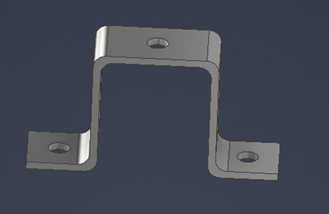
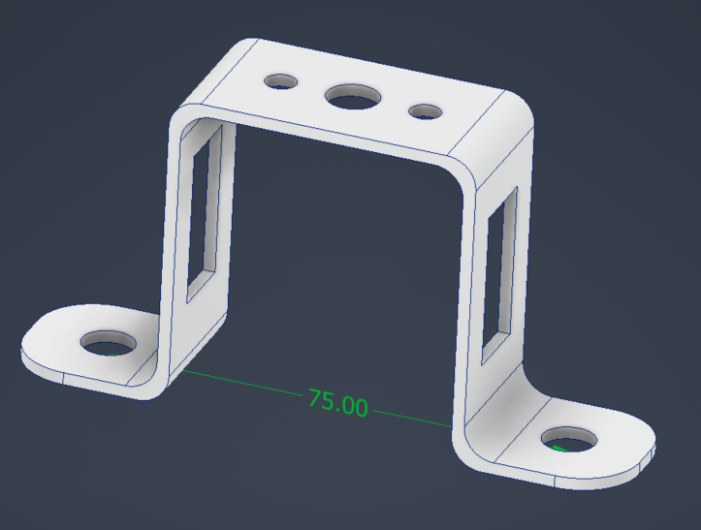
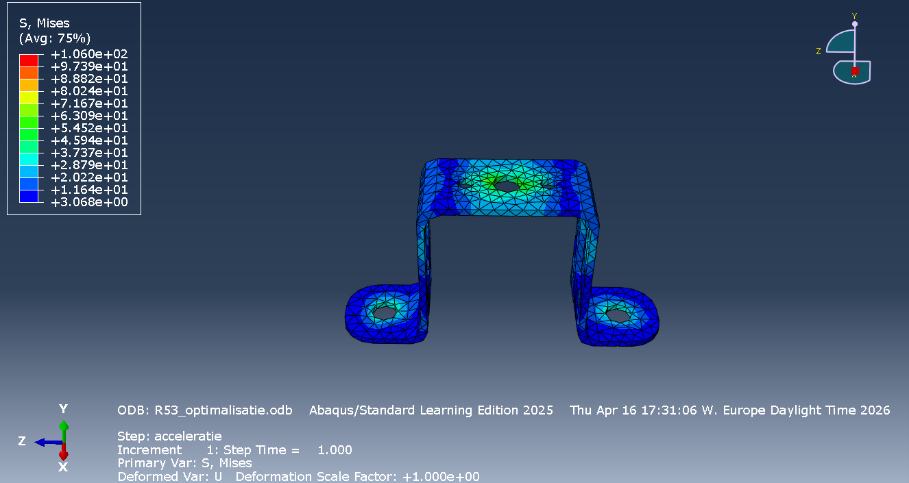
To further optimise the bracket, I modified the design in Inventor. I reduced the material thickness from 3.0 mm to 2.0 mm and rounded off the corners of the bracket to remove unnecessary weight. I also created cut-outs in the vertical legs of the bracket, as the previous analysis indicated that there was too much unnecessary weight there. Finally, two 5 mm holes were made on top, next to the mounting hole, to remove further weight. These modifications led to a new simulation which showed that the maximum stress had increased from 68 MPa to 106 MPa, and the weight had decreased from 114 grams to 22 grams. This bracket has a safety margin of 2.26, which does not yet meet the requirement of 1.2–1.5.
Limit value and final Design
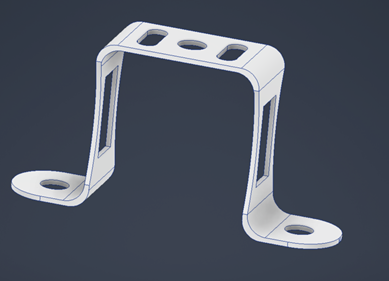
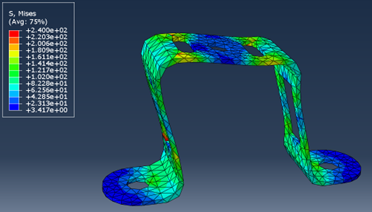
In the following simulation, the material thickness has been reduced from 2 mm to 1.5 mm. Furthermore, the vertical recesses have been widened and the holes on top have been modified into oval notches. The new weight of this bracket is 15 grams. The maximum stress recorded was 240 MPa, which is equal to the yield strength of aluminium. This meant that the bracket had a safety margin of 1.0, and I had to work backwards from there.
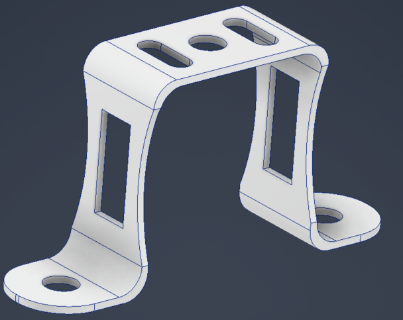
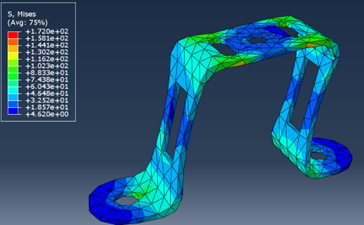
In the final design, the thickness was increased slightly from 1.5 mm to 1.8 mm and the width of the vertical notches was reduced slightly, as the simulation indicated that this was where the greatest stress was concentrated. This resulted in a final design weighing 18 grams and a peak stress of 172 MPa, which corresponds to a safety factor of 1.4, thereby meeting the requirements.
This gives us the final results of the optimisation:
- Thermical: IAT reduced by 14°C, resulting in a stable 240 pk.
- Mechanical: Peak load of 450 Newton successfully absorbed.
- Lightweight: The weight per bracket has been reduced from 150g to 18g (an 88% reduction).
Here is the full report of this study (in Dutch)
Document:12891da2-fff9-462f-9ab1-f7ea617c8e86
Grade: 8.0
Drawings and analysis results
Below are the analyses and the corresponding inventor drawings.